
Have you ever wondered what really makes a starting battery different from a deep cycle one? The main distinction lies in how they deliver power.
A starting battery provides a quick, high-intensity burst to turn over your engine, while a deep cycle battery supplies steady energy over time for longer use.
Understanding these differences helps you choose the right battery for your needs.
The details below will clarify everything you need to know.
What Exactly Is a Starting Battery Designed to Do?
A starting battery is specifically designed to deliver a high-current burst, typically hundreds of amps, needed to crank your engine. This short, powerful surge gets the engine turning over swiftly, which is essential for starting a vehicle. Because of this focus, it’s built to handle short, shallow discharges—using only about 1 to 3 percent of its capacity per start—rather than deep, sustained power drain. The chemistry inside prioritizes rapid high-current delivery over long-duration energy output, making it reliable in crucial moments. To ensure reliable connections for this high-current flow, using quality battery terminals can minimize resistance and maintain peak performance. Unlike deep cycle batteries built for prolonged energy drain, a starting battery is optimized for this singular task.
Cold weather makes this function even more important. Thicker engine oil and sluggish chemical reactions in low temperatures require a strong Cold Cranking Amps (CCA) rating to ensure your engine starts when it’s cold outside. Without this burst of power, the engine may not turn over, leaving you stranded. Once the engine starts, the vehicle’s alternator takes over to recharge the battery quickly, so it’s ready for the next start. This design ensures the starter battery endures many short cycles without significant wear, focusing on shallow discharges by purpose. For precise verification of such electrical output, using top voltmeters with resistance can confirm the battery’s health and performance.
Why Starting Batteries Use Thin Plates
Starting batteries use thin plates because they need to deliver high bursts of current quickly. Thin plates increase the surface area where the electrochemical reaction occurs, which accelerates the battery chemistry. This design allows the battery to produce a large amount of power instantly, essential for starting engines. The thin plates also have lower internal resistance, enabling electrons to flow freely and efficiently.
Additionally, the use of thin plates permits more plates to fit within each cell without increasing the overall size of the battery. This arrangement packs in dense power, providing the quick amperage needed during engine cranking. However, there is a downside: thin plates are less durable during repeated deep discharges. They are prone to damage if you drain the battery completely often. Proper charging practices, such as avoiding full recharges from a deeply discharged state, can help extend the battery’s life. For optimal cable organization, top zip ties can secure these starting battery wires. Using secure wiring techniques prevents accidental disconnection during engine vibration. For boats that also need sustained power, this starting battery design differs from Group 24 and 34 deep cycle options. Overall, this design is optimized for short, powerful bursts rather than long-term energy storage.
How a Starting Battery’s Power Delivery Differs
A starting battery’s power delivery is characterized by delivering a burst of high current—typically 150 to 300 amps or more—for just a few seconds to turn over the engine. This short, intense surge depends on low internal resistance, usually in the low milliohm range, which allows the battery to supply large currents without significant opposition. During cranking, you’ll observe a temporary voltage drop to around 9.5 to 10.5 volts under load; this voltage sag indicates a healthy battery capable of providing the necessary power. Voltage stability in this context means maintaining a narrow range during the surge, not holding a high resting voltage. Once the engine starts, the voltage quickly rebounds, and the vehicle’s alternator takes over the power supply. The battery’s power output during cranking is sharp and brief, optimized for a quick burst rather than sustained current. This design ensures you get rapid engine turnover with minimal delay, after which the battery recharges gradually from the alternator’s continuous output. For similar high-current applications, a properly rated fuse block protects the wiring from overloads during these surges. Choosing a master switch for battery systems can help manage this power flow and ensure safe disconnection during maintenance. A portable solar panel with a plug socket can also serve as a supplemental charging source for the battery between uses.

【Battery Dimensions】Information about this battery, Group size 47 (H5),9.4"*6.9"*7.5",12.78LB. 12.8V 800 CCA. Tips: Please check battery size before purchasing.

✅Batter dimensions: 9.06" L x 6.89" W x 8.82" H, Terminal: Tapered terminal (Left negative (-), Right positive (+)). ✅Please ensure to verify the dimensions and terminal position before making a purchase to guarantee compatibility with your vehicle to avoid any fitment issues.

✅Batter dimensions: 10.75" L x 6.81" W x 8.98" H, Terminal: Tapered terminal (Left negative (-), Right positive (+)). ✅Please ensure to verify the dimensions and terminal position before making a purchase to guarantee compatibility with your vehicle to avoid any fitment issues.
Why Deep Discharges Wreck a Starting Battery’s Life
Deep discharges below 10.5 volts can severely damage your starting battery. When you drain it past this voltage, sulfation prevention measures fail, and crystalline sulfate begins to form on the plates. These crystals coat the plates and increase internal resistance, making it harder for the battery to accept a full charge. As sulfate crystals grow, they crack the plate material, shedding active mass and permanently reducing capacity. For those who frequently power devices from a battery, opting for a 12v 50ah lithium battery with a compatible charger can prevent such deep discharge damage. This process leads to diminished starting power and makes recovery nearly impossible after prolonged deep discharges. Starting batteries are designed to handle only about 1 to 3 percent of their capacity being discharged at once. Going beyond that range causes mechanical damage that accelerates wear. Although slow charging can help restore some lost capacity, deep discharges often drastically shorten the battery’s lifespan, often forcing you to replace it sooner than expected. For inverter setups, selecting the right fuse is equally critical to protect the battery from overloads and short circuits. Choosing a battery with a higher group size like Group 31 instead of Group 24 provides greater reserve capacity to better withstand occasional heavy draws without deep discharge damage.

🔋 DEPENDABLE DEEP CYCLE POWER – Power your next trip with the Newport 12V 50Ah Deep Cycle Lead Acid Battery, designed to deliver steady, consistent power for trolling motors and other 12V marine electronics.

Easy-to-Read LCD Meter – HWE Energy 12V 25Ah LiFePO4 battery come with a dedicated LCD Meter that shows real-time voltage and SOC power with one button press. Never-worry about forgetting to charge when you need it most. Note: Please recharge with a lithium battery charger when below 20%

【Superior Performance】: Lithium iron phosphate battery has high energy density, Long cycle life, Good safety performance, No memory effect, etc. NERMAK LiFePO4 battery has built-in 100A BMS protection to prevent overcharge, Over-discharge, Over-current and short circuit, and excessive low self-discharge rate ensuring up to 1-year maintenance-free storage.
Where to Use Each Battery Type
Starting batteries are designed primarily for engine cranking in cars, trucks, and motorcycles. They deliver a high burst of current needed for ignition, making them essential for daily drivers. Deep cycle batteries, on the other hand, are better suited for steady, prolonged power delivery. They are ideal for RVs, boats, golf carts, and solar energy systems, where consistent power over time is necessary. When choosing between a deep cycle and regular battery for your boat, you must consider performance, cost, lifespan and fit to determine the best option for your specific needs. For optimal longevity, always follow safe watering practices when maintaining a marine battery.
For vehicles like RVs and boats, roles are typically divided: a starting battery handles ignition, while a deep cycle battery supplies power to auxiliary systems such as lighting, refrigerators, or trolling motors. Off-grid solar setups depend heavily on deep cycle batteries because they can store energy for extended periods without frequent recharging.
Maintenance requirements also differ. Starting batteries need only infrequent checks since they are used intermittently and can be quickly recharged by the engine’s alternator. Deep cycle batteries require regular maintenance like equalization and water top-ups to ensure longevity and performance. Your charging methods should align with each type: use alternator charging for starting batteries, and multistage chargers for deep cycle batteries to avoid sulfation and to maximize lifespan.

🔋6000+ CYCLES AT 80% DOD – Premium Grade-A LiFePO4 cells deliver genuine 6000+ charge cycles while maintaining 80% capacity (4000+ cycles at 100% DOD). Up to 10 years of reliable deep cycle performance, replacing multiple lead-acid batteries. Perfect for solar systems, home backup power, and RV applications.

MEET THE GEN5X2 — 37% smaller and 43% more powerful than the GENM2. It’s our most compact and advanced onboard charger yet—engineered for peak performance in the harshest marine environments.
Marine-Grade Confidence: Harness the endurance and dependable energy you need to power every journey on the water, on the road, off the grid, or wherever adventure takes you.
CCA vs. Amp-Hours: What Each Rating Means
Cold Cranking Amps (CCA) measures your battery’s ability to start an engine in cold weather, specifically its capacity to deliver a high burst of current at 0°F for 30 seconds while staying above 7.2 volts. This rating indicates the strength of your battery’s engine-starting power in low temperatures, making it crucial for winter conditions. A higher CCA number means your battery can provide more immediate, powerful bursts of energy to turn over the engine when the temperatures drop. Typically, vehicles used in colder climates benefit from batteries with a CCA of at least 600 amps, though the ideal number depends on your vehicle’s size and engine requirements. Similarly, solar panel performance can also be impacted by temperature, affecting energy output in cold conditions.
Amp-hours (Ah) measure the total stored energy within a battery—how long it can supply a steady current over time. For instance, a 100 Ah battery can theoretically provide 5 amps for 20 hours or 10 amps for 10 hours. This rating relates to the battery’s capacity to sustain continuous, lower-level power over extended periods, making it essential for applications like deep-cycle uses or running accessories. Unlike CCA, which focuses on short bursts, Ah indicates how long your battery can keep things running consistently. Batteries with higher Ah ratings are suited for devices or vehicles that require steady power over many hours, rather than quick starts. Because deep cycle batteries are designed for this sustained power delivery, boaters often consider an AGM deep cycle battery a reliable choice for running electronics without sacrificing safety or performance.

BATTERY SPECS: 12-Volt, 800 Cold Cranking Amps, Size: 10.06" Long x 6.94" Wide x 7.88" Tall, Weight: 38.8 pounds, Dual SAE & GM Posts, C20 Capacity: 50 AH

Fast Starting Power: This 12V 70Ah 760 CCA delivers strong, steady starts is ready for any weather in any season.

Unstoppable Power in Any Weather: This 12V 50Ah battery delivers 570 cold cranking amps (CCA) for reliable starts, whether it’s a freezing winter morning or a scorching summer afternoon.
When a Dual-Purpose Battery Works (and When It Doesn’t)
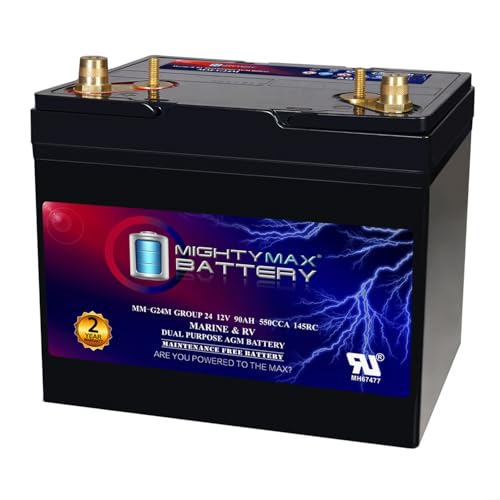
A dual-purpose battery works best for small, single-battery boats like runabouts or fishing skiffs. It handles starting and light loads such as navigation lights, fish finders, and bilge pumps. You can also use it as a backup cranking battery in a two-battery system, providing emergency-start reserve for modest house loads. For powering sensitive electronics like a pure sine wave inverter, a dual-purpose battery may still work, but it cannot match the consistent performance of a deep-cycle battery over long periods. The total charging time depends on factors like battery capacity, charger output, and the battery’s current state of discharge. However, the marine battery weight of a dual-purpose unit typically falls between standard starting and deep-cycle batteries, reflecting its compromise in construction.
However, it’s not suitable for heavy trolling-motor use or powering large electronics, which can drain it faster than a true deep-cycle battery and shorten its lifespan. Frequent short trips undercharge the battery, so smart charging strategies are necessary to keep it functional. For high-demand house banks or cold-weather starts, dedicated batteries remain the better choice. Remember, a dual-purpose battery is a compromise—ideal for moderate use, but not built for intense or extended demands.

[Dual Purpose]: The WEIZE BCI Group 31M is a dual purpose deep cycle sealed AGM marine and RV battery. It features an outstanding starting power and deep cycling capability for long-lasting power supply. Terminal: Left : Positive (+)-Red, Right: Negative (-)-Black.

Dual Purpose Use: This LiFePO4 lithium battery delivers 800CCA to start vehicle or marine engines. Its also provides 60Ah capacity to power outdoor speakers, fans, trolling motors, fish finders, and more.

SPACE-SAVING DESIGN --- A dual purpose marine battery eliminates the need for two separate units by combining the functions of a starter and deep cycle battery. This frees up space in your boat and simplifies your electrical system.
What Happens When You Deep Cycle a Starting Battery
Deep cycling a starting battery severely shortens its lifespan and diminishes its ability to perform reliably. Unlike deep-cycle batteries, starting batteries are designed with thin plates that are optimized for short, high-current bursts, not frequent deep discharges. When you deep cycle a starting battery, its plates shed active material with each cycle, which quickly reduces capacity and performance. Applying battery terminal grease helps protect connections from corrosion, which is especially important in a marine environment where moisture and salt accelerate damage. Repeated deep discharges lead to sulfation, where lead sulfate crystals form and harden on the plates. This buildup blocks the flow of current, making it harder to accept a charge and impairing overall battery performance. As a result, your engine may struggle to start, especially in cold weather when cranking power is crucial.
Internal resistance also increases as the battery ages under these conditions, generating more heat and accelerating internal damage. Over time, this damage becomes irreversible. If you consistently deplete a starting battery below 80% of its charge, you significantly expedite its failure. Ignoring this vital maintenance rule ensures you’ll face premature replacements, often when you least expect them.