
Wondering how long it takes to charge a marine battery? The answer typically ranges from 4 to 12 hours, but it really depends on your battery’s size and how much charge it needs.
A nearly empty battery can take longer than one that’s only partially drained. Keep reading to see how these times are calculated and what factors influence charging speed.
How Long Does a Marine Battery Take to Charge? (4–12 Hours on Average)
A marine battery typically takes between 4 and 12 hours to fully charge, depending on its size, the charger’s power output, and the current state of the battery. Faster chargers with higher amps can shorten this time, but it’s important not to overdo it to avoid damaging the battery’s internal plates. During the charging process, always keep an eye on the temperature—if the battery overheats, stop charging immediately. To ensure you have the right equipment, consider browsing reviews of plastic battery boxes that accommodate various battery sizes for safe storage. Using a charger compatible with your battery’s chemistry, whether flooded, AGM, or gel, helps ensure a safe and efficient charge. For optimal connections during charging, using top post battery terminals can reduce resistance and improve performance. Patience during charging not only protects your battery but also extends its overall lifespan. Additionally, cleaning corroded terminal connections before charging helps maintain a safe and efficient electrical flow.
What Affects Marine Battery Charge Time? (Chemistry, Amps, and Depth of Discharge)
Charge time primarily depends on the charging current, which is influenced by three key factors: chemistry, amps, and depth of discharge. The amperage of your charger determines how quickly your battery is replenished. For example, a 10-amp charger will roughly triple the speed of a 3-amp charger, making your charging process significantly faster. Selecting a solar charge controller with proper current regulation optimizes this process for lead acid batteries. For optimal system safety, integrating a master switch isolates the battery during charging setup.
Depth of discharge also impacts charge time; discharging your battery to 50 percent requires only half the capacity to be restored compared to a full 100 percent drain, reducing the overall charging duration. Larger batteries with higher amp-hour ratings demand more energy and thus take longer to fully recharge.
Charging stages further affect the process: the bulk stage delivers high current for rapid initial charging, while the absorption stage slows down as the voltage stabilizes near full capacity, extending the time needed to reach a complete charge. To optimize charging efficiency and battery health, selecting a charger rated at 10 to 20 percent of your battery’s amp-hour capacity is recommended. AGM marine battery owners must also consider that these batteries require specific charging profiles to avoid damage and maintain performance.
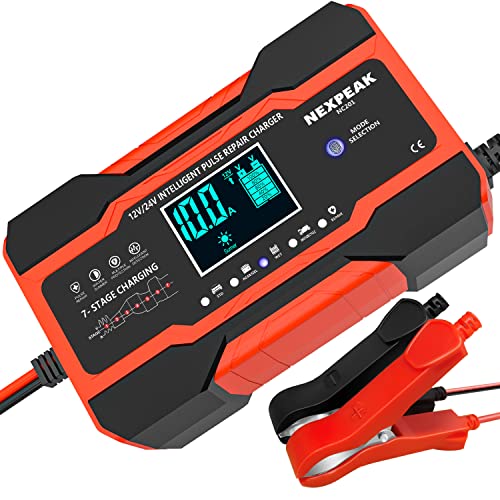
【10-AMP QUICK CHARGER】12V 10-Amp and 24V 5-Amp 7-stage quick battery charger, charging speed is much faster than 8-Amp or 5-Amp automatic chargers. Charge or repair all 12-volt and 24volt lead-acid automotive, marine and deep-cycle batteries including AGM, GEL, SLA, Flooded in cars, trucks, SUVs, motorcycles, lawn mowers, boats marine, etc. Perfect household tool and present for daily use! NEW REPLACEMENT AVAILABLE FOR ANY QUALITY ISSUE.

【2 Bank Marine Battery Charger】output 12V 10A (5A/Bank) waterproof Onboard Boat Charger, which can automatically switch from full charging mode to float charging mode. Works with 12 volt batteries including marine, boat, starter, and deep-cycle batteries.

3 in 1 Battery Charger: Our 10A car battery charger comes with a compact size and 10A 12V super fast charging, compatible with all 12V lead-acid batteries (including AGM, GEL, SLA, VRLA, etc.) and LiFePO4 lithium batteries, functions as a charger, maintainer, and trickle charger for cars, motorcycles, trucks, boats, and more. Please note: This is a car battery charger and please connect it to a power source before use. (Please do not let the charger operating unattended for more than 12 hours.)
How Battery Chemistry Changes Marine Battery Charge Time
Your battery’s chemistry determines how quickly it can accept charge, regardless of the current supplied. Flooded lead-acid batteries are the slowest, primarily because of high internal resistance and electrolyte instability, which extends the final absorption stage of charging. AGM (Absorbed Glass Mat) batteries improve charge acceptance by using an absorbed design; this results in a faster bulk charging phase but still tapers towards the end. Gel batteries charge more slowly than AGM because they require a gentler, lower voltage to prevent structural damage, and manufacturing tolerances can further limit their charging rate. Lithium iron phosphate batteries are the fastest chargers, capable of accepting high current throughout most of the cycle without prolonging the float stage. For example, a 100Ah lithium iron phosphate bank can be fully recharged in 2 to 6 hours, whereas flooded or gel batteries may take 10 to 20 hours with the same 10A charger. To ensure a reliable connection during this process, using best ground cables for your battery setup can reduce resistance and improve charging efficiency. Additionally, safe desulfation methods can help restore capacity and extend the service life of flooded lead-acid batteries over time. A properly wired switch panel can also support safe and efficient battery charging by preventing voltage drops.

[Superior Performance]: Discover superior performance with our upgraded 12V 20Ah LiFePO4 battery. This rechargeable lithium battery offers impressive energy density, long cycle life, and advanced safety features. Equipped with a built-in 20A BMS protection system, it guards against overcharging, over-discharging, over-current, and short circuits. Additionally, its low self-discharge rate ensures trouble-free storage for up to one year
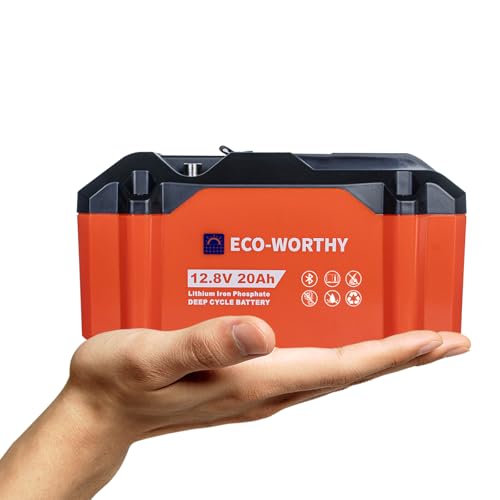
[Compact and Portable]The ECO-WORTHY 20Ah Marine Battery, measuring 8.70 x 4.45 x 4.61 inches, is perfect for small kayaks, traps and amateur radio equipment. Its ergonomic grip design ensures easy handling and portability, providing a reliable power option for amateur radio enthusiasts and campers

【EVE Grade A 3.2V 314Ah Battery Cell】 Manufactured by EVE's automated production lines to ensure cell consistency. Nominal capacity: 314Ah (actual measured capacity: 330Ah). Individual cell energy: 1004.8Wh, meeting high energy storage demands. EVE Grade A prismatic lithium iron phosphate cells deliver high energy density and extended cycle life.
How Charger Amps Affect Marine Battery Charge Time
The current of your charger, measured in amperes, directly influences how quickly your marine battery recharges. A higher amp rating results in a faster charge: for example, a 100Ah battery discharged to 50% will take about 5 hours on a 10-amp charger, compared to around 16.7 hours on a 3-amp charger. To optimize battery maintenance, aim to match the charger’s amp output with your battery’s capacity. For a 100Ah bank, using a charger rated between 10 to 20 amps is ideal, while a 200Ah bank benefits from a 20 to 40-amp charger. It’s important to select a charger with an appropriate amperage—too low, and charging takes too long; too high, and it risks exceeding safe limits. A good rule of thumb is to choose a charger that provides 10% to 30% of your battery’s amp-hour rating. Remember, as the battery nears full charge, charging slows regardless of amp rating, so the amperage primarily predicts how quickly the process will occur. For physically securing your marine battery and its charger cables, consider using cable ties with screw holes for a tidy and reliable installation. Many modern chargers include smart features that automatically adjust current to prevent overcharging, enhancing both safety and battery lifespan. When managing multiple connections from a charger to a battery bank, using top battery terminals designed for multiple leads can simplify wiring and improve reliability.
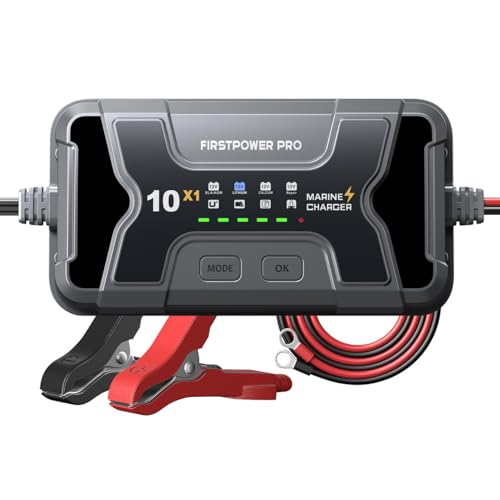
【10X1, 1-Bank, 10A Per Bank】: Marine battery charger for all types of lead-acid & lithium-ion 12V batteries, including marine, boat, starter & deep-cycle batteries. IP68 waterproof fully-sealed charging. Boat battery chargers can be charged 24/7 onboard.

Two Battery Type Options: 12 V Lead Acid and 12 V Lithium(LiFePO4); Input voltage: 100-110 V AC, Output: 12 V 10 A
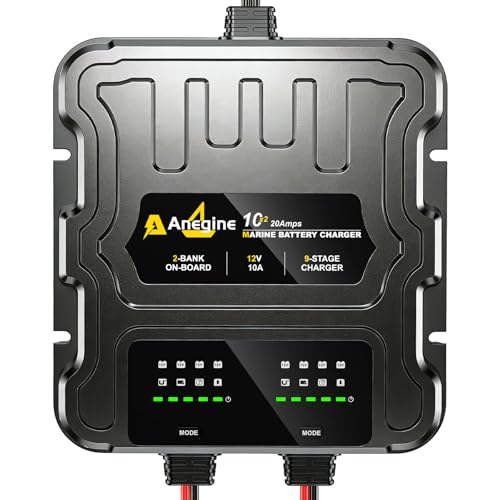
【2 Bank Marine Battery Charger & 10A Max Output】 This professional Marine Lithium Battery Charger features independent 2-bank charging, delivering up to 10A per bank (240W total) to charge two 12V marine batteries simultaneously. This Onboard battery charger perfect for all types of lead-acid & lithium-ion 12V batteries - including marine, boat, starter & deep-cycle batteries. Each bank operates independently to ensure every marine battery receives the precise charge it needs, maximizing performance and lifespan while saving you time and effort on the water.
Why Depth of Discharge Greatly Affects Marine Battery Charge Time
Depth of discharge (DoD) significantly impacts charge time, more so than your charger’s amp rating. When you discharge a 100 Ah marine battery to 50% DoD, you need to replenish 50 Ah. A 10-amp charger can restore that in about 5 hours. However, if you discharge the battery fully to 100% DoD, you must replace 100 Ah. This doubles the approximate charge time to around 10 hours, not counting slower charging phases like absorption and float. Deeper discharges extend these stages, adding hours to your charging process. To optimize charge times, keep your cycles shallow whenever possible. Environmental factors like temperature also influence charging efficiency, but controlling your DoD has the most immediate effect on how quickly you’re back on the water. Using high quality zip ties to secure your battery cables prevents loose connections that can create resistance and lengthen charge times. To speed up charging, ensure you follow the correct battery switch wiring guide to avoid parasitic drain or improper connections that waste time.
Real-World Marine Battery Charge Times: From Partial to Full Depletion
Charging times vary significantly based on how much a marine battery is depleted, charger output, and battery chemistry. For a partially drained battery at around 25% capacity loss, it typically takes 2 to 4 hours to fully recharge. As the depletion increases to 50% or 75%, recharge times extend to 5 to 17 hours or 8 to 20 hours, respectively. These durations depend heavily on the charger’s power output and whether the battery is lead-acid or lithium. Using a top-rated 12v 100ah lithium battery with charger can significantly reduce charge time compared to standard options. For the best performance, pair your battery with a pure sine wave inverter to ensure stable and efficient power conversion during the charging process.
A fully depleted 100Ah lead-acid marine battery generally requires 12 to 20 hours to recharge fully. In comparison, a lithium battery of the same capacity can often be restored in about 2 to 6 hours. Using a charging current of 10 amps for a lead-acid battery usually results in an overnight recharge, while a 20-amp charger can cut lithium recharging time down to just a few hours.
For maintenance purposes, avoid completely depleting lead-acid batteries, as it shortens their overall lifespan. When storing lithium batteries, keeping them partially charged helps preserve capacity better than leaving them fully charged or completely empty.
Which Charger Do You Need for Faster Marine Battery Recharge?
The most effective way to recharge your marine battery quickly is by choosing a charger with a high amperage output. For example, a 50A charger can typically recharge five batteries within four to eight hours, whereas a 10A charger provides only about 5A per bank, resulting in slower maintenance. The charger’s amperage directly influences recharge time—higher-output units deliver faster recovery. It’s important to select a charger compatible with your battery chemistry, whether flooded, AGM, or lithium, as each requires specific charge profiles to optimize performance and avoid damage. Multi-stage chargers enhance speed by pushing through fast bulk charging stages before tapering, ensuring rapid recovery without harming the cells. Good heat dissipation, through forced-air cooling or distributed-on-demand systems, is essential for maintaining high-amperage output without overheating your charger. For instance, a 36A triple-bank charger can reduce recharge times for three batteries to four to eight hours, compared to about eight to ten hours with a 20A charger. The NOCO GEN5X2’s fully-sealed waterproof design allows it to operate reliably in harsh marine environments without performance degradation. Size your charger according to your bank’s amp-hour capacity rather than just the number of batteries, and you’ll experience significantly faster recharging.

Efficient, Energy-Saving, and Fast Charging: The TowerTop 12v battery charger offers 4 adjustable current settings (2A/10A/25A/AUTO) to meet your diverse needs. With a max charging current of 25A, you can fully charge a 100Ah battery in under 3.5 hours. Achieving an 85% charging efficiency (industry average 75%), this battery chargers is more efficient, increasing charging speed by 1640% compared to 2A car battery charger. Not only is it energy-efficient, but it also saves you a lot of wait time

MEET THE GENIUS1 — Similar to our G750, just better. It's 35% smaller and delivers over 35% more power. It's the all-in-one charging solution - battery charger, battery maintainer, trickle charger, plus desulfator.
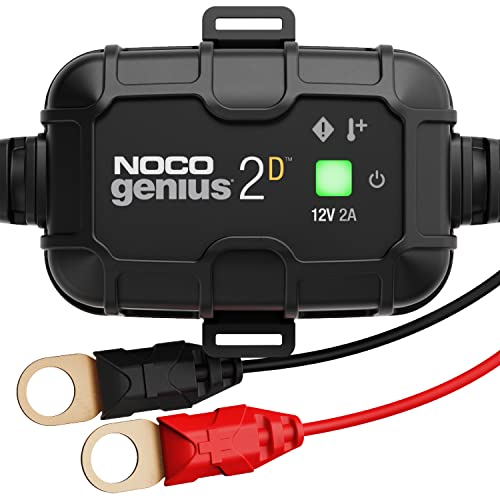
MEET THE GENIUS2D — The all-new direct-mount onboard battery charger for an under-the-hood battery charging system and year-round battery maintenance.
How to Estimate Your Own Marine Battery Charge Time
To estimate your marine battery’s recharge time, you’ll need to know the battery’s rated amp-hours (Ah) and your charger’s output amps. First, determine how much of the battery’s capacity is discharged. For example, if you’re at 50%, you need to replenish 50% of the battery’s capacity. Multiply that percentage by the Ah rating to find the amp-hours needed; for a 100Ah battery at 50% discharge, that would be 50Ah. Divide that number by your charger’s output amps to get the base recharge time—in this case, 50Ah divided by 10A equals 5 hours. For a reliable connection during the charging process, consider using high-quality MC4 connectors to ensure efficient power transfer. Deep cycle batteries, while offering deeper discharge capabilities, involve safety and performance trade-offs when used in a standard car’s starting system. Using a proper inline fuse holder can help protect your charging circuit from potential overloads.
For lead-acid batteries, it’s advisable to add a 20% charging-loss factor to account for inefficiencies and heat loss during charging. Using the previous example with a 10A charger, you would multiply the base time by 1.2, resulting in approximately 6 hours. Keep in mind real-world factors such as battery age, temperature, and maintenance can impact actual recharge times, so rounding up and allowing extra time is always wise to prevent surprises.

MEET THE GEN5X2 — 37% smaller and 43% more powerful than the GENM2. It’s our most compact and advanced onboard charger yet—engineered for peak performance in the harshest marine environments.

【5X2, 2-Bank, 5A Per Bank】: Marine battery charger for all types of lead-acid & lithium-ion 12V batteries, including marine, boat, starter & deep-cycle batteries. IP68 waterproof fully-sealed charging. Boat battery chargers can be charged 24/7 onboard.

MEET THE GENPRO10X1 — 41% smaller and 33% more powerful than the GEN1. It’s our most compact and advanced onboard charger yet - engineered for peak performance in the harshest marine environments.