
Wondering how to tell if your deep cycle battery is still good? The key is checking its voltage, capacity, and overall health with simple tools.
By understanding the right test steps, you can determine whether it needs recharging or replacement before you get stranded.
Keep reading to learn the exact procedures to accurately assess your battery’s condition.
Rest Your Battery Before Testing
To get an accurate reading, you must rest your battery after fully charging it. First, ensure your charger completes its full cycle; a partial charge leaves an unreliable baseline. Disconnect all loads and chargers, including small draws, because even minimal current can interfere with the test. Next, allow the battery to rest for at least four hours, though overnight is ideal to fully dissipate surface charge. Shorter rest periods only produce temporary voltage effects that falsely inflate your readings. During this wait, the battery’s electrolyte balance stabilizes, and the surface charge naturally dissipates. If you are using a lithium battery, consider that a top trickle charger can maintain the battery at its ideal resting voltage throughout this period. Keep the battery in a stable, room-temperature environment and avoid temperature fluctuations, which can distort voltage. Do not rush this process—letting the battery settle completely ensures you measure its true state of charge, free from surface effects. For ongoing monitoring, experienced boaters often recommend a battery monitor to track performance and safety trade-offs. Choosing a reliable master switch can also help prevent accidental drain during rest periods by fully isolating the battery from parasitic loads.
What Your Multimeter Tells You About a Deep Cycle Battery?
A 12.6 to 12.8-volt reading indicates a fully charged deep cycle lead-acid battery at rest. This voltage range suggests the battery has about 100% capacity remaining. If your multimeter shows around 12.4 volts, the battery is approximately 75% charged, while 12.2 volts signals about 50% capacity. Below 12.0 volts, the battery is deeply discharged and requires immediate recharging to avoid damage. Unlike cold cranking amps, which measure a battery’s ability to start an engine in cold conditions, deep cycle batteries are designed for sustained power delivery over time. For solar systems, a solar panel fuse protects the wiring from overcurrent and prevents potential fire hazards.
It’s important to note that this voltage measurement reflects only the open-circuit voltage, not the actual capacity under load. To get a reliable reading, ensure the battery has been at rest for a few hours before testing to allow surface charges to dissipate. Keep in mind, a healthy voltage reading alone does not guarantee full performance; combining this with other tests provides a clearer picture of your battery’s condition. For optimal electrical connections, consider using high-quality battery terminals similar to those recommended for top post batteries.
How to Check Specific Gravity on Flooded Lead-Acid Deep Cycle Batteries
To check electrolyte health and the true state of charge on flooded lead-acid deep cycle batteries, use a hydrometer to measure specific gravity. Fully charged cells typically show readings between 1.255 and 1.275 at 77°F; lower readings indicate discharge. Remove the vent caps, draw electrolyte into the hydrometer, and read the level at eye level for accuracy. Record the specific gravity for each cell—significant differences among cells may suggest imbalance or sulfation. Always correct readings for temperature: add 0.001 for every 3°F above 77°F, and subtract for lower temperatures. Perform this test only when the battery is fully charged and in a well-ventilated area. Do not test immediately after adding distilled water; the electrolyte needs time to mix evenly. Checking each cell’s specific gravity provides a detailed picture of battery health that a multimeter cannot offer.

BATTERY HYDROMETER: This battery tester is made to stand up to tough treatment in service stations & garages. It's designed so that both customer & technician can see the state of the battery acid..Fit Type: Universal

ACCURATE MEASUREMENT - No need to heat the battery, the specific gravity of the plumbic acid liquid battery is instantly and accurately displayed, no difficult float readings are required and no thermometer is required.
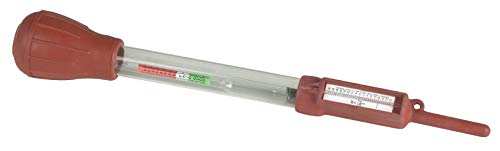
Hydrometers test the state of charge of a battery cell by measuring the specific gravity (density) of the electrolyte - the greater the concentration of sulfuric acid, the more dense the electrolyte becomes
The Correct Way to Load Test a Deep Cycle Battery
To load-test a deep cycle battery accurately, you need a load equal to half of its amp-hour rating. For example, if you have a 100Ah battery, apply a 50-amp load. First, ensure your battery is fully charged and has rested for a short period to eliminate surface-charge effects. Connect your tester securely, with positive to positive and negative to negative terminals. Apply the load carefully and monitor the voltage throughout. The test should last between 10 and 15 seconds—no longer—to prevent overstressing the battery. Immediately remove the load after this interval. A healthy 12V deep cycle battery maintains a voltage of at least 9.6 volts during testing. If it dips below this threshold, the battery may be weak. Also, before testing, clean the terminals and verify tight, corrosion-free connections to prevent false readings. Many portable solar panels with plug sockets are designed to recharge these batteries, but using secure battery straps ensures your wiring stays fixed during the test. A compatible solar charge controller helps prevent overcharging during the recharging process. testing battery condition ensures your setup remains reliable. If the results are borderline, retesting is recommended to confirm the battery’s condition.

🔥【A MUST HAVE TOOL IN YOUR GARAGE】 - With up-to-date testing technology, it provides a quick reading to determine whether a vehicle battery needs a jump or replacement and also the output status of the alternator. All you have to do is log in and play. Save your time and money.

RUN 3 TESTS WITH 1 DEVICE: Diagnose battery health, charging system performance, and starter motor draw all from one automotive battery tester—no need for separate tools cluttering your bench.

BATTERY TESTING: This handy tool helps you test battery condition and load, check starter motor draw (alternator test), and assists with charging system diagnosis.
What Recovery Speed Reveals About Deep Cycle Battery Capacity?
Recovery speed reveals a lot about your deep cycle battery’s health. When you remove a load, the terminal voltage should bounce back quickly if the battery is in good condition. A fast recovery indicates low internal resistance and a high usable capacity. If the recovery is slow, it usually signals sulfation or aging, which reduces the battery’s ability to accept charge and limits its amp-hour capacity. A key factor in maintaining fast recovery is ensuring the battery is properly housed in a marine battery box to protect against vibration and moisture that accelerate internal damage. Watching how much active material remains helps determine overall health. For those undertaking similar projects, a fuse block can help manage electrical loads reliably. This kind of slow recovery can also stem from corroded connections that interrupt current flow, similar to how a faulty shore power cord sparks due to poor contact.
But don’t mistake a quick surface-charge bounce for true capacity. This rapid rise can be superficial. Instead, monitor how the voltage recovers over several minutes after removing the load. Comparing this recovery against a baseline for your specific battery type can help you gauge its condition. Keep in mind, a battery that recovers well initially but drops under load still might lack sufficient reserve capacity. Persistent slow recovery even after proper charging suggests permanent capacity loss that you shouldn’t ignore.
When to Recharge or Replace Your Deep Cycle Battery
You should recharge your deep cycle battery when its voltage drops to 12.2V (50% charge) to prevent damage from deep discharges. Ideally, recharge it at 12.4V (75% charge) to minimize sulfation, which can diminish capacity over time. Monitoring voltage recovery after a load gives insight into the battery’s health; sluggish recovery or consistently low voltage suggests the battery is deteriorating. Similarly, heat shrink tubing can be applied to protect battery cable connections from moisture and corrosion. For optimal long-term maintenance, using a charge controller for li-ion can help prevent overvoltage and extend battery life.
Replace the battery if it cannot reach a full-charge resting voltage of 12.6 to 12.8V after proper charging. Persistent voltages around 12.0V or a rapid drop after charging indicate severe sulfation or internal damage. Also, watch for physical signs like swelling, leakage, or excessive heat during charging. If your battery repeatedly fails to perform its intended duty cycle, it’s time to replace it rather than attempting recovery.

Charger, Maintainer & Desulfator - An all-weather battery charger, battery maintainer, trickle charger, and battery desulfator. Perfect for charging and maintaining all 12-volt lead-acid, flooded or sealed maintenance free batteries (AGM and gel cell).
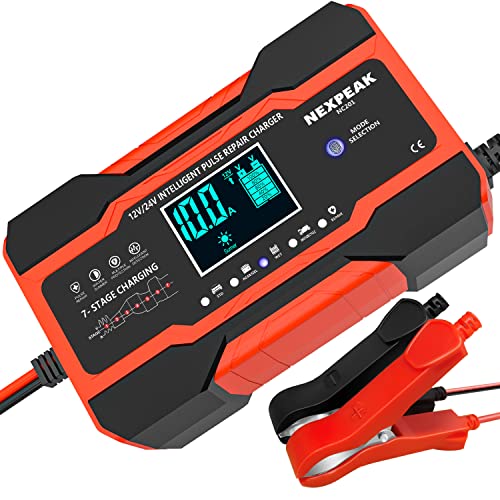
【10-AMP QUICK CHARGER】12V 10-Amp and 24V 5-Amp 7-stage quick battery charger, charging speed is much faster than 8-Amp or 5-Amp automatic chargers. Charge or repair all 12-volt and 24volt lead-acid automotive, marine and deep-cycle batteries including AGM, GEL, SLA, Flooded in cars, trucks, SUVs, motorcycles, lawn mowers, boats marine, etc. Perfect household tool and present for daily use! NEW REPLACEMENT AVAILABLE FOR ANY QUALITY ISSUE.

[25A Suitable For LiFePO4 Lead-Acid Battery Charger] 12V 25Amp, 24V 15Amp battery charger, 5 Level adjustable current 2A/8A/20A/25A/AUTO can meet your different needs. Additionally, Charge or repair all 12V and 24V lead-acid automotive, Lifepo4, marine, and deep-cycle batteries, including AGM, GEL, SLA, Flooded in cars, trucks, SUVs, motorcycles, lawnmowers, boats, marine, etc.