
If you’re trying to decide between a Group 24 and a Group 35 battery, you’re likely wondering which size will fit your vehicle and provide enough power.
The main difference is in their physical size and starting power, with the Group 24 being slightly longer and offering higher cold-cranking amps.
Keep reading to see how these factors can help you choose the right battery for your needs.
Why Battery Group Size Matters More Than You Think
The group size number is crucial because it determines if your battery will physically fit into your vehicle. This number, which standardizes case dimensions and terminal placement, ensures the battery sits securely in the tray and that the cables reach properly. The Battery Council International (BCI) specifies that batteries within the same group should stay within about 2 millimeters of each other in size, making it essential to choose the correct group for installation. An incorrect group size can prevent you from installing the battery, even if the voltage matches.
This number primarily indicates the case size—not just power output. A larger group size typically means a bigger case, which can hold a larger capacity or more powerful internal components. However, battery chemistry and manufacturing quality vary widely within the same size or group. Two Group 24 batteries, for example, might look similar, but their starting power and capacity could differ significantly.
Matching the group size is the first step, but don’t assume performance based solely on case dimensions. Internal construction, materials used, and overall quality play crucial roles in how well a battery performs. Always verify that the internal design aligns with your vehicle’s needs after confirming the appropriate group number. For example, when comparing Group 24 and Group 31 batteries for boating, the larger Group 31 case typically offers higher reserve capacity and amp-hours for deep-cycle applications. For those seeking advanced charging solutions, consider using smart chargers for lithium ion to optimize battery lifespan and safety. When selecting tools for installation, using high-quality crimping tools ensures reliable terminal connections and prevents electrical faults.
Group 24 Vs Group 35: How the Physical Dimensions Stack up
Compared to Group 35, Group 24 is longer at 10.25 inches, which is a 1.19-inch difference and often determines whether the battery fits your tray. The width varies slightly, with Group 35 being just 0.0625 inch wider, and both groups share the same height at 8.875 inches. This size difference impacts tray compatibility more than anything else; choosing the wrong group can lead to installation issues because of a mismatched fit. Charging compatibility isn’t affected by size since both groups support standard 12V charging systems. However, variations within each group from different manufacturers can alter the exact fit, so always measure your tray before purchase to ensure proper fit. To isolate power during maintenance, you should also consider a high-quality master switch for battery systems to safely disconnect the circuit. For boaters, an AGM deep cycle battery offers improved safety and performance over standard flooded batteries, making it a popular recommendation for marine applications. To maintain optimal performance, you’ll want to pair your chosen battery with one of the best lithium battery chargers for 12V devices.

FITS GROUP 24 BATTERIES: Securely holds standard marine and RV batteries up to 10.125 inches tall; interior measures 10.6 x 7 x 10.125 inches for a stable and precise fit
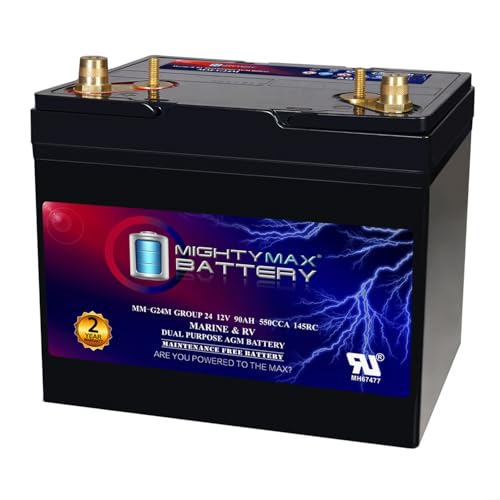
Marine-Grade Confidence: Harness the endurance and dependable energy you need to power every journey on the water, on the road, off the grid, or wherever adventure takes you.
Which Vehicles Use Group 24 Vs Group 35 Batteries?
Vehicles that typically use Group 24 batteries are larger platforms and vehicles with higher electrical demands, such as full-size trucks and SUVs like the Ford F-150, Chevrolet Silverado, Toyota 4Runner, and Jeep Grand Cherokee. They are also common in cargo vans, buses, and agricultural equipment, where more space and power capacity are needed. For boaters, understanding these batteries can help when selecting a trolling motor battery that can be charged on the water with portable gear. When upgrading these batteries, pairing them with quality battery terminals ensures a secure connection that handles the higher current loads without corrosion or voltage drop. A Group 31 battery, for example, offers even greater reserve capacity for sustained marine use.
In contrast, Group 35 batteries are suited for compact and mid-size passenger vehicles. You’ll find them in Japanese and North American sedans like the Toyota Camry, Honda Accord, and Nissan Altima, as well as in compact SUVs and crossovers such as the Toyota RAV4, Honda CR-V, and Subaru Forester.
To ensure proper fit, always check your vehicle’s original battery tray size and terminal orientation. Verify the BCI group number printed on your current battery label before purchasing a replacement. Regular battery maintenance can extend its lifespan, and if you are considering alternative power sources, make sure your new battery matches your vehicle manufacturer’s specific requirements, not just the brand.

BCI Group Size: 24Voltage:

✅Batter dimensions: 10.75" L x 6.81" W x 8.98" H, Terminal: Tapered terminal (Left negative (-), Right positive (+)). ✅Please ensure to verify the dimensions and terminal position before making a purchase to guarantee compatibility with your vehicle to avoid any fitment issues.
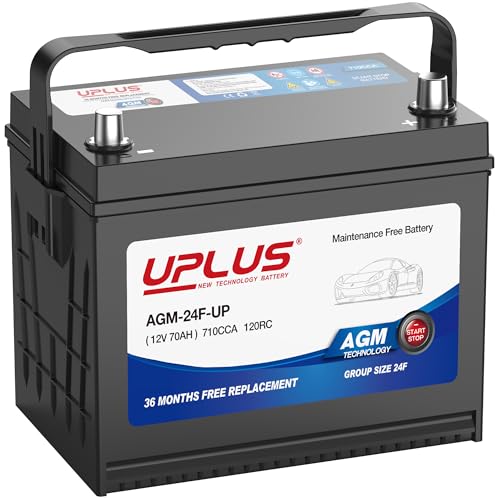
Battery dimensions --- BCI Group size 24F, 10.7 x 6.77 x 8.98 inches, Terminal Layout: Left: - Right: +. Battery dimensions, cold cranking amps, terminal location and battery type are key factors in getting the right unit. Please measure your old battery and compare the size with this battery, if the measurements are the same, the positive and negative positions are the same, there is not much difference in CCA and it will fit your vehicle.
Cold-Cranking Amps: Which Battery Starts Your Car Better?
Cold-cranking amps (CCA) is a measurement of a battery’s ability to start your car in cold temperatures. It indicates the number of amps a battery can deliver for 30 seconds at -18°C without dropping below a specified voltage. For example, a battery with a CCA of 700 can supply 700 amps during that period, helping your engine turn over in cold weather. Since different battery group sizes have similar CCA ratings, size alone isn’t enough to determine performance. A higher CCA, such as 765 on a Group 35 AGM battery, will generally start your car more reliably than lower CCA options like 525 on a Group 35. However, it’s important to match the manufacturer’s recommended CCA for your vehicle to ensure optimal charging and battery lifespan. Higher CCA can help in extreme cold but only if the battery physically fits your vehicle’s requirements. On a boat, cold cranking amps matter for starting marine engines in harsh conditions where reliable power is essential. For reliable installation, using a quality crimping tool ensures secure cable lug connections to the battery terminals. If you notice a similar sparking issue when connecting your battery, it may be related to loose electrical connections that mimic the problems seen with shore power cords.
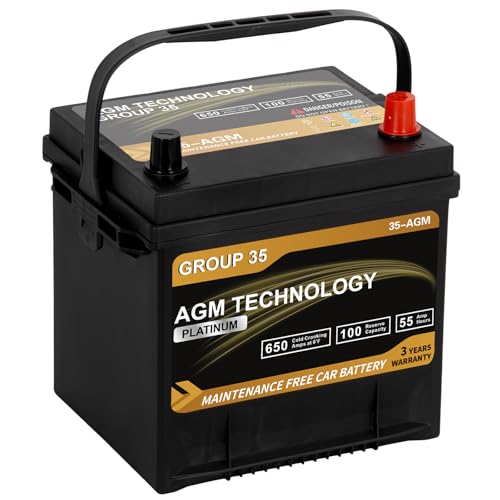
✅ Perfect Fit & Compatibility: BCI Group Size 35, 12V 55Ah, 650CCA, 100RC. Dimensions: 9.06" L x 6.89" W x 8.82" H. Terminal: Tapered terminal (Left negative (-), Right positive (+)). Ensure proper fit by comparing the size, terminal position, and CCA with your original battery. This ensures compatibility and avoids any fitment issues for your vehicle.

✅Batter dimensions: 9.06" L x 6.89" W x 8.82" H, Terminal: Tapered terminal (Left negative (-), Right positive (+)). ✅Please ensure to verify the dimensions and terminal position before making a purchase to guarantee compatibility with your vehicle to avoid any fitment issues.
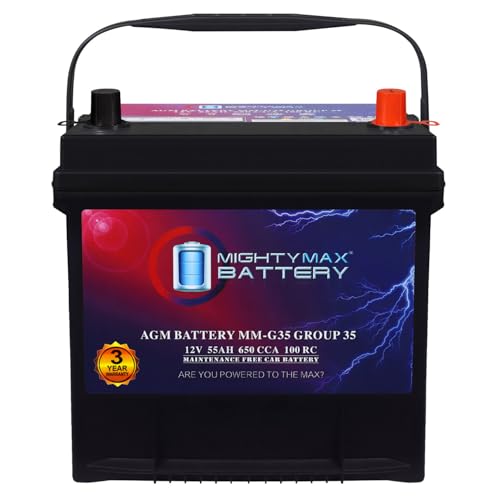
Fast Starting Power: This 12V 55Ah 650 CCA delivers strong, steady starts is ready for any weather in any season.
Reserve Capacity vs Amp-Hours: Which Spec Actually Matters More?
Reserve capacity (RC) is more practical for real-world use, measuring how long a battery can sustain a fixed 25-amp load before dropping to 10.5 volts. This duration directly indicates how much runtime you’ll get when running accessories without the engine running. Amp-hours (Ah), on the other hand, is a theoretical rating based on a 20-hour discharge rate. While Ah is useful for solar applications and deep-cycle batteries, it can be misleading for short, heavy loads because it assumes a slow, steady discharge that doesn’t match real-world conditions. Some battery users require an immediate physical disconnection method, often relying on a kill switch with lanyard for rapid emergency cutoff in vehicles or equipment.
For assessing which spec matters more: RC provides a clear picture of practical backup time and battery endurance under typical moderate loads. Ah offers a ballpark estimate of capacity but is less accurate for high-current, short-duration uses. Don’t rely on converting Ah to RC or vice versa; these are rough approximations and don’t reflect actual performance under different conditions. If your priority is backup time during engine-off situations or running accessories, RC is your better benchmark. For starting engines or planning for deep discharge cycles, both specs can be informative, but RC delivers the most relevant practical insight.

Fast Starting Power: This 12V 70Ah 710 CCA delivers strong, steady starts is ready for any weather in any season.

BATTERY SPECS: 12-Volt, 720 Cold Cranking Amps, Size: 9.38" Long x 6.75" Wide x 7.69" Tall, Weight: 31.7 pounds, SAE Posts, C20 Capacity: 44 AH

Extreme-duty battery tray for Automotive, Marine, RV batteries
Group 24 Vs Group 35: Which Battery Should You Buy?
Choosing between a Group 24 and Group 35 battery depends mainly on physical fit and your vehicle’s specific needs. Measure your battery tray to ensure the larger 10.25-inch-long Group 24 fits securely, which is ideal for vehicles with room for a longer case. The smaller Group 35, with its 9-inch footprint, suits compact engine bays and models like Honda, Nissan, or Toyota that require a more portable size. Remember, bigger isn’t always better— a secure fit is crucial to prevent movement that can shorten your battery’s lifespan.
Next, confirm Charging compatibility by comparing your vehicle’s alternator output with the battery’s ratings. Group 24 batteries typically offer 550 to 800 cold cranking amps (CCA), providing versatile starting power, while Group 35 batteries generally deliver 550 to 650 CCA. Match the terminal orientation to your current setup to avoid wiring issues. Always follow your vehicle manufacturer’s recommended group size to ensure proper installation and to reduce the risk of premature battery failure.

✅ Perfect Fit & Compatibility: BCI Group Size 24F, 12V 70Ah, 710CCA, 120RC. Dimensions: 10.75" L x 6.81" W x 8.98" H. Terminal: Tapered terminal (Left negative (-), Right positive (+)). Ensure proper fit by comparing the size, terminal position, and CCA with your original battery. This ensures compatibility and avoids any fitment issues for your vehicle.

Fast Starting Power: This 12V 70Ah 710 CCA delivers strong, steady starts is ready for any weather in any season.

Durable and Rugged: Group 24 battery tray made from high-impact polypropylene plastic, it is corrosion-resistant and impact-resistant, making it suitable for harsh environments such as vehicles and boats.