
If you’ve ever wondered about the right size battery for your boat or travel trailer, a Group 24 might be just what you need. It’s a 12-volt power source known for balancing size and performance.
It offers around 500 to 800 cold cranking amps and 60 to 100 amp-hours.
This makes it suitable for providing reliable power for light to moderate loads.
Keep reading to see how it compares and what fits best for your setup.
Will a Group 24 Battery Fit Your Vehicle or Boat?
Your vehicle or boat may fit a Group 24 battery, but measuring is essential before purchasing. Check your compartment’s dimensions—length, width, and height—to ensure the battery will fit comfortably. It’s also important to verify terminal orientation because Group 24 and Group 24F batteries have opposite terminal polarities. Additionally, assess your hold-down system; straps or clamps require some vertical space for secure tightening. The Seachoice Battery Tray includes a quick-disconnect buckle to secure batteries without fully encasing them. For marine applications, confirm that your tray resists corrosion and keeps the battery stable against wave movement. Proper maintenance involves keeping terminals clean and tight. If storing your boat or RV for an extended period, removing the battery and storing it in a cool, dry place while maintaining a charge is recommended. Using high quality wire strippers can help ensure clean and reliable electrical connections during installation. Additionally, a mini heat gun ensures precise control for applying shrink tubing around battery terminals for added insulation and safety. Ensure that the battery cables can reach without stretching and that nothing obstructs the hood or cover. Never guess—measure thoroughly first.
Group 24 Dimensions: Length, Width, and Height
“Group 24” refers to a standardized battery size with specific dimensions: approximately 10.25 inches long, 6.8125 inches wide, and 8.875 inches tall. These measurements define the physical footprint of the battery, which is crucial for fitting it properly in your compartment. Keep in mind that with terminals included, the total height reaches about 9.375 inches, so check clearance in tight spaces to ensure the lid will close without issue. To maintain reliable connections, it is also important to prevent battery terminal corrosion by using quality terminals and routine maintenance. If you need more starting power or longer runtime, consider whether Group 31 batteries offer a better fit for your boat’s demands.
When selecting or securing a Group 24 battery, verify the exact dimensions match your tray or compartment. Start by confirming the length from front to back, then check the width from side to side, and finally measure the height to ensure there is enough room. Small variations across brands or models may occur, so always compare your battery to the standard BCI dimensions to avoid fitting problems. Proper sizing not only guarantees a secure fit but also assists with maintenance and ventilation considerations. For optimal electrical performance, pairing your battery with quality top post terminals ensures reliable connections and power delivery.
Group 24 Electrical Specs: Voltage, CCA, and Amp-Hours
Group 24 batteries typically have a nominal voltage of 12 volts, though lithium versions may read 12.8 volts. This voltage level is standard for automotive and marine starting batteries. Cold-cranking amps (CCA) usually range from 500 to 800 CCA, with most models falling around 550 to 700 CCA. Higher CCA numbers indicate better performance in cold weather, making starting more reliable. Amp-hour capacity generally falls between 60 and 100 Ah, with common models offering around 70 to 85 Ah. This capacity influences how long the battery can power deep-cycle applications. If your priority is starting power, choose a higher CCA rating; for extended runtime, opt for a higher Ah rating. Maintenance requirements vary: starting batteries tend to need less regular attention, while deep-cycle or dual-purpose batteries benefit from consistent charge checks to extend lifespan. For accurate diagnostic work, using a voltmeter with high internal resistance ensures precise voltage readings without draining the battery. For vehicles where you want to prevent battery drain when parked, installing a remote battery disconnect switch can offer added security and control. Always confirm the specifications on the battery label, as Group 24 refers to the size—not a fixed performance standard. For recharging on the go, consider pairing your battery with portable solar panels that include plug sockets for direct device charging.
Flooded, AGM, or Lithium: Which Group 24 Chemistry Works Best?
Choosing the right chemistry depends on your needs and budget. Flooded batteries are the cheapest initially but require regular maintenance, including watering and electrolyte checks, which can be time-consuming and messy. AGM batteries are sealed and maintenance-free, offering better vibration resistance and the ability to recharge faster, making them a good all-around upgrade. Lithium batteries carry the highest upfront cost but excel in weight savings, offering deeper usable capacity and an average cycle life that often exceeds 2,000 cycles, making them ideal for long-term, high-performance applications. For a trolling motor, the actual runtime also depends on battery capacity and amp draw. Regardless of chemistry, achieving proper performance also requires tight battery terminals to prevent voltage drop and arcing in marine environments. Regular cleaning of those terminals using a baking soda solution and a wire brush helps prevent corrosion buildup that can compromise electrical connections. Your selection should reflect your priorities: go with flooded if you want a simple, budget-friendly option, choose AGM for durability and low upkeep, or opt for lithium if maximum longevity and performance matter most to you.

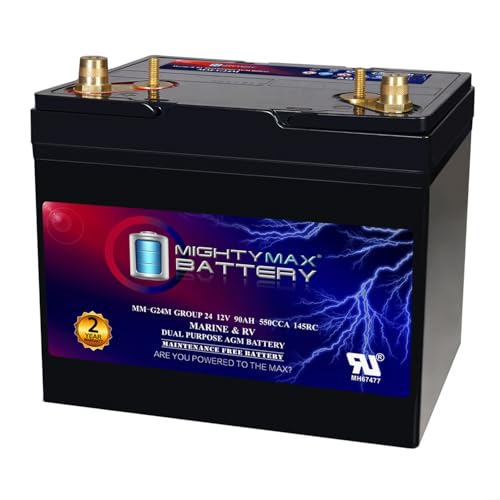
DUAL PURPOSE MARINE RV BATTERY: Interstate's marine dual-purpose AGM battery can serve as both your cranking battery to start the motor & power your trolling motor - whether the motor is on or off! Built "Interstate tough" to withstand the most rugged conditions so you can spend more time having fun & less time worrying about your battery

Maintenance-free Absorbed Glass Mat (AGM) technology - no water required, no spills, no leaks, and no maintenance
Marine-Grade Confidence: Harness the endurance and dependable energy you need to power every journey on the water, on the road, off the grid, or wherever adventure takes you.
Best Marine and RV Uses for Group 24 Batteries
In an RV, these batteries serve as house power for light to moderate use. You can run RV appliances like water pumps, fans, and refrigerators, especially during weekend trips. A single Group 24 battery suits low-demand camping with shore power, while pairing two doubles the capacity for light boondocking. They fit small travel trailer trays well, but don’t expect them to sustain heavy inverter loads. To ensure reliable performance, it helps to verify your battery’s condition with a quality battery tester. Pairing them in a dual battery system is a common setup to achieve longer run times without overtaxing a single unit. Choose them when space is tight and your power needs stay modest. Routinely applying controlled desulfation techniques can help extend the battery’s usable life by breaking down sulfate crystals that reduce capacity.

FITS GROUP 24 BATTERIES: Securely holds standard marine and RV batteries up to 10.125 inches tall; interior measures 10.6 x 7 x 10.125 inches for a stable and precise fit

Includes lift-off lid, durable woven hold-down strap, foot clamps and stainless steel screws

【Product Overview】Designed for deep cycle energy storage applications, SUPER EMPOWER LiFePO₄ batteries provide reliable power for RV, marine, trolling motor, and off-grid systems, featuring premium LiFePO₄ cells and an integrated BMS for protection against overcharge, over-discharge, overcurrent, short circuit, and temperature extremes; ideal for auxiliary and house power needs in mobile and outdoor setups, ensuring stable and long-lasting performance. Designed for energy storage use only, this battery is not suitable for engine starting or cranking applications.
Group 24 vs. Group 27 vs. Group 31: How They Compare
When you move from a Group 24 to a Group 27 or 31 battery, you increase both capacity and size. A Group 24 is lightweight and compact, usually weighing around 40 to 50 pounds, making it easy to handle and fit into tight spaces. Upgrading to a Group 27 adds about two inches in length and roughly 15 pounds, providing a noticeable boost in amp-hours without significantly altering your installation needs. Stepping all the way up to a Group 31 results in a longer and heavier battery—up to 75 pounds—offering the highest capacity among these options. However, with the increased size and weight, you need to ensure your tray and mounting hardware can accommodate the larger dimensions and extra weight safely. Pay attention to ventilation, especially with lead-acid types that release gases during charging, as bigger batteries in confined compartments may require improved airflow. For larger lithium setups, a solar charge controller is essential to regulate charging and prevent damage. Always measure your available space before selecting a higher-capacity battery to avoid fitment issues. For safely managing power distribution from these larger batteries, consider a master switch to control the electrical load.

Extreme-duty battery tray for Automotive, Marine, RV batteries

FITS GROUP 24 BATTERIES: Securely holds standard marine and RV batteries up to 10.125 inches tall; interior measures 10.6 x 7 x 10.125 inches for a stable and precise fit

Heavy-Duty Construction – Made from rugged, non-corrosive black plastic for long-lasting performance in marine environments.
CCA vs. Amp-Hours: What Matters for Your Group 24 Setup
CCA and amp-hours serve different purposes when sizing a Group 24 battery. CCA, or cold cranking amps, measures the burst of power needed for engine starting, especially in cold weather, typically around 500–800 amps. Amp-hours, on the other hand, indicate the battery’s storage capacity, usually between 70–85 Ah, which determines how long accessories like lights or a trolling motor can run. If your primary need is reliable engine starts in frigid conditions, prioritize CCA. If you require longer run times for electronics or trolling motors, focus on amp-hours. Selecting a battery with high CCA but low amp-hours may improve starting reliability but reduce battery life during deep cycling. Conversely, a high-amp-hour battery that lacks sufficient CCA may struggle with engine starts, particularly in cold climates. Be aware that your charging process also differs: deep-cycle batteries with high amp-hours need a longer absorb stage, while starting batteries benefit from quick, high-current bulk charging. For dual-purpose setups, you might compromise on both metrics to gain flexibility, but understanding your load profile helps in making the best choice. When using the battery for trolling or electronics, note that deep cycle marine batteries are designed to handle repeated discharges without damage. For comparison, a marine battery often combines starting power and moderate deep-cycle capability, but dedicated deep cycle types typically last longer under constant accessory use. When powering an inverter, prioritizing amp-hour capacity ensures sustained performance for long-duration loads.

【Advanced Smart BMS & All-Weather Safety】Equipped with an upgraded 100A Smart BMS, our battery provides comprehensive protection against overcharge, over-discharge, over-current, and short circuits. Unlike standard lithium batteries, it features automatic low-temperature cut-off, preventing charging below 32°F (0°C) to avoid cell damage. Built with stable LiFePO4 chemistry, it eliminates the risk of thermal runaway, ensuring maximum safety for your RV, boat, or home energy system in any season.

Includes lift-off lid, durable woven hold-down strap, foot clamps and stainless steel screws

【Perfectly Replacement for Lead-acid Batteries】Lithova 12V 100Ah Group 24 Lithium Iron Phosphate Battery(LiFePO4) is the perfect choices for lead-acid battery conversion and upgrading. The voltage application range of our LiFePO4 batteries is almost the same as that of lead-acid batteries, And the weight of our battery is only 22.57lbs, they are 35% smaller and 70% lighter than ordinary lead-acid batteries, and the energy density has been increased by 3-5 times. 【Note】This battery is suitable for energy storage rather than start-up engine.
Group 24 Terminal Styles and Subgroup Labels Explained
Choosing the right Group 24 battery means paying attention to more than just its size. You need to match the terminal style and subgroup label to your vehicle’s specific setup. Most Group 24 batteries feature standard SAE top-posts for the terminals, but some catalogs also list top-and-side variants. Don’t rely solely on the group number; variations like 24F, 24R, 24H, and 24T specify differences in polarity or height.
For example, a 24F shifts to right-hand positive polarity, meaning the positive terminal is on the right side when facing the battery. Conversely, a 24R indicates a reverse-polarity arrangement, which swaps the terminal positions. The 24H and 24T suffixes often refer to height changes or lid fit adjustments. Always check the printed subgroup suffix on the battery case and verify the polarity before making a purchase. This ensures your cable routing and tray fit without issues.
How to Match a Group 24 Battery to Your Application
To match a Group 24 battery to your application, focus on key measurements and specifications. The standard dimensions are approximately 10.25 inches in length, 6.81 inches in width, and 8.88 inches in height. Measuring your compartment to match these dimensions ensures proper fit without clearance issues. Pay attention to terminal height as well, since additional space is often needed for lid clearance and easy cable connections.
Next, determine your electrical needs. For moderate house loads, aim for a capacity of 70–85 amp-hours (Ah). If you’re prioritizing starting power, look for a cold-cranking amps (CCA) rating of 500–800, which indicates reliable engine cranking ability. Clarify your role: deep-cycle batteries are ideal for sustained loads such as solar systems or trolling motors, starting batteries are designed for short bursts of high current, and dual-purpose batteries combine features of both.
Verify the battery’s voltage, which should be 12 volts for standard automotive and marine applications. Consider the chemistry as well: absorbed glass mat (AGM) batteries are most common and compatible with many systems, whereas lithium batteries require different charging procedures and are usually more expensive.
Finally, match the battery to your specific use case—small boats, weekend RVs, or backup power stations. Proper maintenance, including terminal cleaning and correct charging practices, will help maximize the lifespan of your battery. Balancing fit, capacity, and intended application ensures you select the right Group 24 battery for your needs.

Fast Starting Power: This 12V 70Ah 710 CCA delivers strong, steady starts is ready for any weather in any season.

SPACE-SAVING DESIGN --- A dual purpose marine battery eliminates the need for two separate units by combining the functions of a starter and deep cycle battery. This frees up space in your boat and simplifies your electrical system.

ML75-12 Internal Thread is a 12V 75AH group 24 Sealed Lead Acid (SLA) rechargeable maintenance free battery - UL Certified