
Figuring out whether to use a circuit breaker or a fuse on your boat can be confusing.
The right choice depends on where you need quick resets, regular switching, or reliable protection, especially in salty conditions.
Understanding their differences helps you keep your boat’s electrical system safe and running smoothly.
Keep reading to see where each one fits best.
Why Overcurrent Protection on a Boat Is Really About Your Wires
Since your boat’s wiring carries the current, overcurrent protection is primarily about safeguarding those wires. The main goal is to prevent overheating and melting of insulation that can lead to fires. To do this, you select a fuse or breaker rated at or below the wire’s ampacity—the maximum current it can handle safely. This sizing should be based on the smallest wire in the circuit because that wire determines the overall safety limit. For example, selecting the correct solar charger without battery ensures your device receives consistent power without compromising the circuit’s ampacity limits.
Installation conditions also affect safe current capacity. Wires routed through hot engine compartments or bundled closely with others can carry less current without overheating. When wiring multiple batteries, remember that a series vs parallel configuration changes the total current available and the wire sizing required. Corrosion on connections adds resistance, which increases heat build-up even if the fuse or breaker is correctly rated. Regularly inspecting and maintaining connections is essential to keep resistance low. Choosing terminals made from high-conductivity metals ensures minimal voltage drop and reliable current flow at every connection point.
Ultimately, the wire’s limits govern your protection choices. Always choose a breaker or fuse that operates at or below the wire’s rated current, then confirm it can handle your typical load without nuisance trips. Properly sizing and installing your overcurrent protection ensures your wires stay safe, preventing damage that could compromise your boat’s safety and performance.
Fuse vs. Circuit Breaker: Marine Strengths Compared
Circuit breakers are the better choice for marine applications because they are reusable and specifically designed to withstand harsh environments. Unlike fuses, which are single-use and require replacement after a fault, circuit breakers can be quickly reset, minimizing downtime and making maintenance easier. They are highly effective in main panels where easy access is essential and often serve as both protection devices and switches. In contrast, when selecting a battery, understanding the differences between Group 24 and 34 options is crucial for performance and fit. Marine-certified circuit breakers are built to handle vibrations, moisture, and salt air, ensuring reliable performance in tough conditions. Fuses, on the other hand, work best in tight spaces where a switching function isn’t necessary. During battery maintenance, circuit breakers allow you to isolate circuits without pulling out replacements, whereas fuses demand spares for each circuit. Your choice hinges on the circuit’s location and how swiftly you need to restore power. For example, if a battery shows signs of failure like swelling or corrosion, it confirms the fault and signals the need for immediate replacement. A smart charger with advanced charging algorithms can prevent such battery damage by automatically adjusting voltage and current to optimal levels.
Where to Place Overcurrent Protection on Every Circuit
Place overcurrent protection as close as possible to the power source, ideally within 7 inches of the battery terminal along the conductor. This location ensures the protection device shields the wiring from faults before they can cause damage further downstream. Always install the fuse or circuit breaker on the positive, ungrounded conductor and follow proper grounding practices to prevent shorts. If the wire runs are fully enclosed in a sheath or panel, you can extend the placement distance—up to 40 inches from a non-battery source or 72 inches from a battery—without sacrificing safety. Remember, your goal is to safeguard the entire wire run; leaving unprotected wire between the source and the overcurrent device creates a fire hazard. When selecting the protection device, consider a master switch for battery systems to combine switching and overcurrent protection in one unit. For added safety in emergency situations, a lanyard kill switch can instantly disconnect power to prevent accidents. Keep the protected segment as short as possible to minimize risk. Using a crimping tool with cutter ensures reliable connections that prevent faults from developing in the first place.
How to Match Your Fuse or Breaker to Your Wire Size
To match your fuse or breaker to your wire size, start by determining your conductor’s ampacity based on its exact installation conditions. The ampacity of a wire isn’t fixed; it varies depending on factors like insulation type, bundle arrangements, and ambient temperature. For instance, a 10 AWG wire rated at 30A in open air may only safely carry about 24A when bundled or installed in a hot environment such as an engine room. Protect the smallest conductor in the circuit, including any downstream pigtails, as they set the overall ampacity limit. Once you know this value, select a fuse or breaker rated at or below that limit to prevent overcurrent conditions. Achieving a reliable crimp at these connection points is vital, and using quality crimping tools ensures secure terminations that maintain the circuit’s safe capacity. Finally, ensure the device can handle your continuous load without tripping prematurely, but do not exceed the wire’s safe capacity. Proper matching ensures reliable protection without nuisance trips or under-protection risks.

Safety and Reliability with Excellent Performance: Gaoekoius Automotive Fuse Holder Heavy Duty 18AWG Cord is made of multi-stranded galvanized copper wire with high transmission efficiency, excellent heat resistance and conductivity. Fuse connecting terminals are made of high quality phosphor bronze, good elasticity to ensure a better connection of the fuse
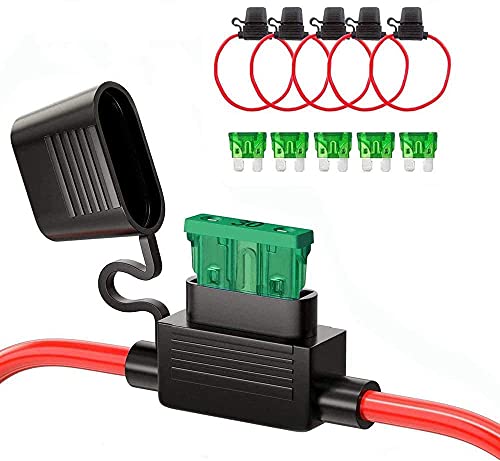
Heavy duty 12AWG wire, better protection to the circuit.

Fuse holder type: AGU fuse holder
Where Fuses Shine: Low-Current, Compact, and Backup Circuits
Fuses are ideal for low-current, compact, and backup circuits due to their simplicity and reliability. For small loads such as radios, navigation lights, and small pumps, blade fuses are a perfect fit. The color coding on fuses allows you to instantly identify the rated current, making maintenance quicker and easier. A secure ground cable connection is equally vital for ensuring these small circuits perform reliably without voltage drops.
Their compact size enables flexible installation options; inline waterproof holders protect isolated accessories from moisture, while multi-circuit blocks help consolidate multiple loads into a single, space-saving unit. Backup circuits benefit from fuses because a blown fuse clearly indicates a fault, simplifying troubleshooting and repairs. Replacing blown fuses is straightforward, especially with spare fuses stored nearby. Dedicated branch fuses isolate faults further, ensuring that if one accessory fails, the entire system remains operational. Terminal-mounted MRBF (Miniature Resettable Blade Fuse) units provide close-to-source protection near the battery in a compact form. For a 24v trolling motor, correct routing and connections are critical to ensure safe operation and prevent damage. Understanding trolling motor runtime helps you anticipate when low-current backup circuits may be needed during extended trips. Overall, fuses deliver low cost, quick replacement, and small form factors, making them a practical choice for many low-current and backup applications.
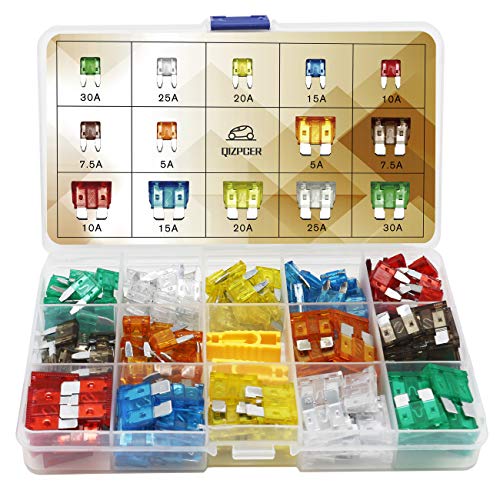
Easy Identification: Made of a high quality zinc alloy, with a transparent cover and color coded
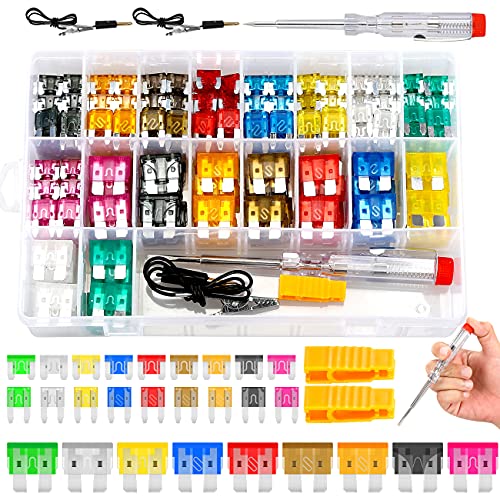
306PCS FUSES KIT: A full fuse set of 3 different sizes : Standard & Mini & Low Profile Mini,9 model: 2A/ 5A/ 7.5A/10A/ 15A/ 20A/ 25A/ 30A/ 35A,covers 27 commonly used blade fuses: 3 different sizes*9 models.Well organized in a plastic container,included: 90pcs Standard Fuses(10PCS of each model );108pcs Mini Fuses(12PCS of each model );108pcs Low Profile Mini Fuses(12 PCS of each model ).

[MINI FUSE KIT]: The mini fuses automotive kit includes 120pcs: 2A/3A/5A/7.5A/10A/15A/20A/25A/30A/35A(12PCS of each model ), and equipped with a fuse puller.
Where Circuit Breakers Win: Main Panels and Frequent Switching
Circuit breakers are the ideal choice for boat main panels where centralized control and frequent switching are needed. They serve as both protection devices and ON/OFF switches, making them indispensable in these settings. You’ll primarily find them in main AC panels because they combine circuit disconnection, overload protection, and control within a single unit. This arrangement simplifies load balancing across devices such as your water heater, air conditioner, and outlets. Double-pole breakers are essential here as they disconnect both conductors, complying with electrical codes for shore-power disconnection near the connection point. Circuit breakers excel in situations where you need to switch circuits often, such as controlling panel-mounted accessories. Instead of replacing components when a circuit trips, you simply reset the breaker at the panel. This quick action reduces downtime and offers instant visual confirmation of the circuit’s status. Proper labeling and grouping of loads help you navigate the panel easily from your helm station, saving time during troubleshooting. Push-to-reset marine circuit breakers further streamline maintenance, allowing you to restore power swiftly without searching for spare parts. For instance, if your shore power cord sparks, a tripped breaker can be reset immediately at the panel without replacing a fuse. Overall, for centralized control and frequent circuit management, breakers outperform fuses by providing convenience, speed, and improved safety.

Amperage: 30A AC/30A DC, Color: White, Actuator Style: Toggle, 2 poles, Max Voltage: 120V AC/ 240V AC/ 65V DC, Interrupt Capacity: 3000A @ 120V AC/ 3000A @ 240V AC/ 1500A @ 240V AC [TUV]/ 3000A @ 240V AC [UL 1077]/ 7500A @ 65V DC, Mounting Screw Torque: 6 in-lb (0.68 Nm), Screw Terminal Torque: 14 in-lb (1.58 Nm)

30 Amp Magnetic Hydraulic Circuit Breaker: Rated 125–415V AC and 65–80V DC; meets ABYC & UL standards for marine and vehicle safety.

Double pole, 50 Amp, 240V type QP Circuit Breaker
The Startup Problem: Protecting Motors Without Nuisance Blows or Trips
Proper overload coordination begins with knowing your motor’s operating and starting current. Start by selecting overload protection that comfortably handles the motor’s rated load, then verify it can tolerate the inrush current during startup. Always follow ABYC guidelines: use protective devices suitable for motor current, not just generic branch circuit protectors. If a circuit trips repeatedly at startup, the issue is typically a curve mismatch—not a faulty motor. To prevent nuisance trips and nuisance blows, choose slow-response overload devices that can handle the motor’s starting surges while maintaining fire safety standards, and ensure your wiring connections pass through the box lid using proper routing to avoid chafing or shorts that could compromise protection coordination.

UNIVERSAL COMPATIBILITY:The WYFWFDF Boat Transom Saver is specifically designed to support single ram trim and tilt systems, and is compatible with Yamaha, Mercury, Suzuki, Evinrude, Honda and Tohatsu outboard engines, providing essential protection for your outboard engine during towing and minimising stress on the boat's transom

Product Name : Thermal Overload Relay;Model : FR2-25(LR2-13);Contact Type : 1NO 1NC;Pole Number : 3P

Don’t Skimp on Marine-Rated Devices in Saltwater
Corrosion resistance is non-negotiable for marine-rated devices in saltwater environments. Regular household circuit breakers or fuses are not designed to withstand constant exposure to salt spray, moisture, and seawater. Instead, opt for devices with sealed contacts and corrosion-resistant housings, such as those rated IP67 or higher, which ensure protection against water ingress in wet areas like bilges or decks. For Li-Ion setups, ensure the charge controller includes proper low-voltage disconnect to protect battery longevity. Tinned copper wiring helps slow corrosion at the strand level, but you must also seal every terminal thoroughly to prevent saltwater intrusion. For battery terminals, following manufacturer torque specs is critical because overtightening can strip threads or crack the battery case, while terminals that are too loose cause arcing and voltage drops. Remote battery disconnect switches often feature sealed, marine-grade enclosures that mirror this same level of protection, ensuring reliable shutoff without exposing internal contacts to the elements. Avoid relying on generic “waterproof” labels—verify that devices meet ABYC standards or carry specific marine certifications. Failing to select marine-rated equipment increases the risk of wiring failure, short circuits, and potential hazards, making skimping here a false economy. Your boat’s safety and reliability depend on it.

Branch circuit breakers (can also be used for 24-hour circuit protection)

Protect your system: using as circuit breaker and battery Disconnect, allows to charge or maintain the battery without having to disconnect all the wires; Protect excessive current between battery or electrical from damage

Branch circuit breakers (can also be used for 24-hour circuit protection)
A Simple Decision Guide for Choosing Fuses or Breakers
Use a fuse for compact, high-fault primary protection near the battery. It’s simple and cost-effective. Fuses are ideal when you want a straightforward, one-time protection device that blows quickly when a fault occurs, preventing damage to nearby components. For setups combining solar input with battery charging, a DC to DC charger ensures efficient power transfer between sources. Use a breaker where you need frequent resetting or operational switching on branch circuits. Breakers can be reset easily after tripping, saving you the cost and hassle of replacing a fuse. They are more suitable for circuits that require regular maintenance or adjustments.
When dealing with motors, pay attention to inrush current—an initial surge when the motor starts. Select a device that can tolerate this surge without false trips. Place the protection device close to the power source to respond swiftly to faults. Ultimately, choosing between a fuse or breaker depends on your specific needs: consider the ampacity, fault current levels, and how often you’ll need to reset the device. Balancing these factors ensures reliable, effective circuit protection. For branch circuits, selecting a fuse block with ground bus can simplify wiring and improve safety by providing a dedicated common ground point.