
Worried about whether you need a fuse close to your battery? The quick answer is yes—ideally within 7 inches of the positive terminal.
This small but crucial protection stops short circuits from causing fires by melting insulation or sparking flames. Understanding where and how to install the right fuse is key to wiring safety, and you’ll find all the details below.
The 7-Inch Rule: How Close Your Battery Fuse Must Be
The fuse must be installed within 7 inches (175mm) of the battery or DC source connection measured along the conductor. This distance is critical because it ensures the entire length of unprotected wiring from the source is covered by the circuit protection, which significantly enhances safety. The measurement is taken along the wire itself, not as a straight-line distance. You should mount the fuse at the battery positive terminal or directly on the terminal post; placing it at the load end does not meet the source-side protection requirement. For maximum safety, using high-quality battery terminals ensures a secure, low-resistance connection that supports proper fuse protection. This is similar to how a shore power cord can spark at the connection point if the circuit protection is too far from the source, allowing excessive current without immediate interruption. Buying the right fuse for your solar panel system is also essential because a properly rated fuse prevents overheating and equipment damage.
There are exceptions if the wire is enclosed in a sheath: in those cases, you can extend the fuse placement up to 40 inches for non-terminal runs or up to 72 inches if the wire runs directly to the battery. It is essential that the sheath completely covers the entire length of the wire to qualify for these extended distances. Following these guidelines helps prevent potential electrical fires or damage caused by overloads or short circuits.

Heavy duty 10 (AWG) Gauge red color wire Allows you to splice it into any project

【PROFESSIONAL LINE INSURANCE】 Quelong provides you with 4pcs professional heavy duty 12AWG wire inline fuse holders for better circuit protection, 2pcs each of 15A/20A/25A/30A/40A blade fuses.

Designed for MEGA-Fuses: Securely holds a Victron Energy MEGA-fuse in DC electrical systems.
Fire Risk: What Happens When You Skip the Fuse Near the Battery
Skipping the fuse near the battery creates a major fire hazard. The fuse acts as the critical safety device that protects your wiring from short circuits. Without it, an un-fused section of cable is the weakest link in your circuit. When a short occurs there, uncontrolled current flows directly from the battery, rapidly overheating the wire. This can cause the insulation to melt, sparks to fly, and flames to ignite nearby components. Since the fuse is missing, there’s no way to interrupt the current before damage happens. Using high-quality MC4 connectors ensures secure and low-resistance connections that reduce fire risk. The fire can quickly spread, sometimes involving the battery itself, which worsens the danger. Proper fuse placement close to the battery terminal is essential because it is your first line of defense against electrical fires. Choosing the right master switch for battery systems also helps isolate power safely for maintenance and emergencies. Relying on downstream protection won’t catch a fault immediately; the exposed wire remains a threat until the fuse blows. Even with proper fusing, using heat shrink tubing on exposed wire connections provides an extra layer of insulation and protection. Always install the fuse near the battery terminal to ensure your system is protected and fires are prevented.

Specially designed to protect battery terminals from corrosion, a leading cause of hard starting and battery failure.

Product Type: Fuse rated current: 300A; Maximum rated voltage: 58V DC; Stud Size: 5/16"(M8); Terminal mounting hole: 3/8"(M10)
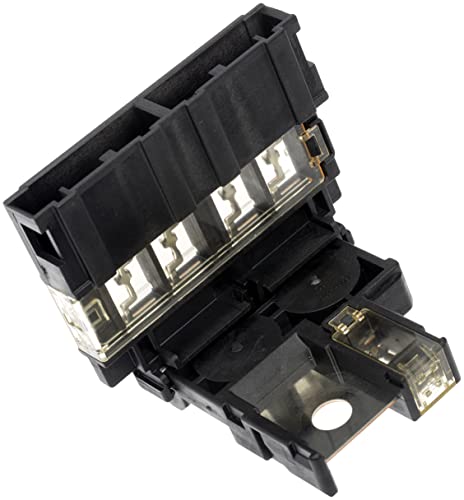
Direct replacement - this battery fuse is designed to match the function of the original fuse in specified applications
Conduit and Starters: When 40 Inches Is Acceptable From the Battery
ABYC allows the fuse to be placed up to 40 inches away from the battery source when using an enclosed or sheathed conductor. This longer distance is acceptable because enclosure protection shields the wire from damage, and sturdy cable insulation minimizes the risk of faults. Nonetheless, it’s best practice to keep the fuse as close to the source as possible. For example, always follow correct routing and connections to ensure the wire is properly secured and protected from chafing. For starter circuits, where high cranking currents make proximity challenging, routing the entire cable through protective conduit justifies the 40-inch maximum distance. Remember, the fuse is designed to protect the wire, not the load. The segment of unprotected wire between the source and fuse increases with distance, so enclosure protection is a conditional allowance rather than a free pass. Always aim to keep the fuse near the source when circumstances permit. For solar systems with lead acid batteries, the charge controller itself monitors battery voltage to prevent overcharging, but the fuse remains essential for short-circuit protection. Reviewing top battery switches can help ensure you select a model with integrated overcurrent protection for a safer installation.

Product type :ELECTRONIC SWITCH

Product: MRBF Fuse 2pcs (Fuse Block NOT Included), perfectly compatible with M8 stud fuse box - single or dual terminal fuse block

【Product Name】: Vehicle and Ship Battery Fuse/Fuse Holder; Rated Voltage: Max 58VDC; Current: 40A
Battery Fuse Distance: Installation Tips for Positive Side and Shielding
The fuse should be placed as close to the battery terminal as possible—ideally within 7 inches or even 5 inches if your equipment requires it. Positioning the fuse near the power source minimizes the length of unfused cable, which is critical for battery safety. If you use protective shielding or conduit, some standards permit extending the distance to around 40 inches, but this is an exception rather than the rule. When selecting a charge controller, ensure the fuse is compatible with the system’s requirements, as top solar charge controllers for Li-Ion batteries often specify precise fuse distances for optimal safety.
Securely mount the fuse holder in a location protected from vibration and moisture. Choose a holder rated for your system’s current to ensure safety and reliability. Remember, sheathing the wire with shielding does not eliminate the need for a fuse; shielding only affects how far the fuse can be located from the battery.
Each positive lead leaving the battery must have its own fuse placed close to the source. Always match the fuse rating to your cable gauge because the fuse’s purpose is to protect the wire, not the device. Proper placement and selection of the fuse help prevent damage and reduce fire risk from overcurrent conditions.

Product Name: Vehicle and Ship Battery Fuse/Fuse Holder; Rated Voltage: Max 58VDC; Current: 100A

FOUR FUSED CIRCUITS: Provides four ATO or ATC blade fuse outputs

The MRBF Terminal Fuse Block package consists of a comprehensive set of components, including one MRBF Terminal Fuse Block, one red insulator cap, one washer, one lock washer, and one M8 hex nut.
Why the Short Wire Between Battery and Fuse Matters Most
The shortest, most critical segment of wire in your circuit is the run between the battery terminal and the fuse. Keeping this wire as short as possible is essential because it’s the most vulnerable part of the system. Any short circuit along this unfused segment can send hundreds of amps directly into the wire insulation. If that insulation wears through or chafes, it can create a dead short that the fuse cannot clear since the short is before the fuse. This can cause the wire to glow, melt, or even start a fire. Industry safety standards recommend the inline fuse be placed within 18 inches of the battery to minimize this risk. You can additionally secure the wire along this short run using cable ties with screw holes to prevent chafing against metal surfaces. For trimming those cable ties flush after installation, using the best flush cutters ensures no sharp plastic edges remain to cut into the wire insulation over time. For verifying the integrity of that short battery-to-fuse run after installation, using a high-impedance voltmeter can help detect dangerous voltage drops or poor connections.
Your primary goal is to protect every inch of wire after the fuse, but the real danger lies in that initial, unprotected segment. An extra inch or two of exposed wire significantly increases fire risk, because the short circuit is uncontrolled and can dump high current directly into the wiring. That’s why you must minimize the length of the battery-to-fuse run. Making this segment as short as possible is the best defense against fires and damage caused by unexpected shorts.

Warning for Parking Monitoring:Park ≤3 days: Connect red wire to vehicle BAT power for parking monitoring;Park >3 days: Connect red wire to vehicle ACC power,Do NOT enable parking monitoring;Do not use parking monitoring if your car battery is over 3 years old.

BATTERIES COMPATIBILITY: Our battery adapter with switch is compatible with Dewalt 20V/18V DCB series batteries for DCB205, DCB206, DCB204, DCB203, DCB200, DCB201, etc. The battery adapter connector is designed to close-fit, ensures stability and prevents the connection from loosening during use (Note: Battery NOT Included)

New Upgrade, USB Power Supply - To make the use process more stable, most dash cams and mirror cameras has been fully upgraded from Mini-USB to a USB C socket, which can largely avoid restarting, high-temperature deformation, and so on. (if you need a hardwire kit, please buy a dedicated USB C hardwire kit. Asin: B0B19LGTF9)