
Figuring out the right length for your shore power cord can feel tricky, especially with all the different setups at docks. You need enough slack for easy connection and movement.
But not so much that it causes voltage issues or safety concerns.
Most boaters find that a 50-foot cord fits well in many marina slips.
Though closer options like 25 or 30 feet work if your boat is near the power pedestal.
Keep reading—there’s more to know about choosing the safest and most effective cable length.
How to Measure Your Pedestal-to-Inlet Distance
Start by mapping out the actual path your cord will follow from the pedestal outlet to your boat’s inlet. Don’t just eyeball a straight line; include dock corners, bends, vertical rises, and any other obstacles. This ensures you’re accounting for the real distance rather than a simplified estimate, which is vital for electrical safety. Once you’ve traced the route, add enough slack for movement and handling—enough for a drip loop and gentle connection without stressing the cord. For added safety, choose a shore power cord built with the same robust materials used in top-rated, battery-free solar chargers, ensuring durable electrical protection against harsh marine conditions. Avoid excessive extra length, as it can create clutter and make cord management more difficult. Measure the full route carefully, then select a cord length that matches this measurement closely. Ensure the mounting location you choose balances access and ventilation requirements similar to a battery isolator install. The goal is to have a cord that isn’t too short—risking disconnection or strain—nor too long, which can cause trip hazards. Additionally, understanding the amp-hour demands of your boat’s battery bank helps you match the cord to the charger’s output, much like selecting between onboard and portable chargers for optimal performance. The most secure and practical fit is the shortest length that still provides comfortable reach and some slack for safe handling. After choosing your length, test it in your actual layout to confirm it fits well and allows for easy connection.

WEATHERPROOF CONSTRUCTION: Watertight molded plug and connector; nickel plated contacts resist corrosion in marine environments

WEATHERPROOF CONSTRUCTION: Watertight molded plug and connector; corrosion resistant nickel plated contacts

Compatible with Nema L5-30P to 5-15/20R: 20ft Heavy duty 30 Amp to 20 Amp shore power adapter Compatible with Nema L5-30P to 5-15/20R, UL Listed Compatible with Nema L5-30P 125 Volt 30 Amp plug male to female Compatible with NEMA 5-20 20 amp T-blade receptacle, 30 to 20 amp marine adapter cord build with STW 10AWG/3 conductors power cord, Note: only work with Max 125Volt, T-Blade 20R is 125 Volt 20amp Compatible with Nema 5-20R NOT 250V 20amp Compatible with Nema 6-20R
Which Common Cord Size Fits Your Slip Layout?
A 50-foot cord is the default all-purpose choice, covering moderate distances easily. It provides enough length for most marina slips, offering a good balance between flexibility and manageability. If your slip is set back from the pedestal or you need some extra reach, a 30- to 50-foot cord allows for better dockside flexibility. For pedestal setups right next to your slip with easy inlet access, a shorter cord, around 25 feet, keeps your area tidy and reduces excess coil and trip hazards. In very tight layouts or limited space, a 12-foot cord minimizes cable bulk and simplifies storage. For atypical slip arrangements, longer custom cords such as 75 or 100 feet might be necessary. Always choose a length that fits your actual run to avoid excess slack and keep your deck safe. For superior electrical connections, consider top post battery terminals if you also need to upgrade your boat’s battery connections for reliable performance. When selecting terminals, look for options that support multiple connections to simplify your battery wiring. A common cause of arcing is a corroded shore power plug or receptacle.


Marine Shore Power Accessory

Marine and Boat Shore Power Extension Cord: 125/250v 50 Amp extension cord.
Does a Longer Cord Really Hurt Performance?
A longer cord doesn’t automatically hurt performance, but it does change the electrical calculations you need to consider. As cable length increases, so does its resistance, which lowers the voltage reaching your equipment. This voltage drop means less power is available for your boat’s devices and generates heat along the cord. If you notice warm plugs or coiled cables during operation, it’s a sign that resistance is impacting performance, not normal use. If you are also working on marine wiring that involves heat shrink tubing, using a heat gun ensures a waterproof seal and long-lasting connection. Choosing a tool like a quality ratcheting crimper ensures you consistently achieve a reliable terminal connection, which is critical for minimizing resistance in any power setup.
Performance issues become most evident under heavy loads, such as running an air conditioner or water heater. It’s important to understand that length isn’t the only factor—cable gauge matters too. A longer, thicker wire can often outperform a shorter, thinner one because it has less resistance. To minimize voltage drop, use the shortest practical run and keep connectors clean and free of corrosion. If you notice your gear dimming or operating sluggishly, it indicates your voltage efficiency has dropped too far, and you may need to upgrade your cable or reassess your setup. Just as with battery terminals, selecting the right terminal type can significantly affect connection quality and performance under load.
30-Amp vs. 50-Amp: Maximum Safe Cord Lengths
The maximum safe cord length is approximately 50 feet for a 30-amp shore power cord and around 50 feet for a 50-amp cord. For a 30-amp setup, the use of 10 AWG wire supports this length comfortably, minimizing voltage drop and reducing the risk of power surges that could harm your electronics. Going beyond 50 feet can cause voltage drops significant enough to impact performance or damage devices, especially if the cord is exposed to weather elements. Always ensure the connectors are waterproof to prevent corrosion and maintain consistent conductivity.
With 50-amp cords, the heavier 6 AWG conductors allow longer runs — typically up to 50 feet safely. Some manufacturers offer lengths up to 100 feet, but note that derating may apply. This means the maximum load may reduce from 50 to around 45 amps when exceeding 50 feet. To keep your setup safe, use the shortest possible cord that reaches your pedestal and always verify waterproof connectors to prevent overheating. Matching wire gauge to load capacity and length safeguards your equipment and ensures consistent power delivery. Proper battery system design also benefits from correctly sized shore power cords to avoid similar voltage drop issues.

Maximum Waterproof Seal: Reaplacement sealing connecting collar ring creates a watertight connection between your RV power cord and adapter - Shields against rain, moisture, and corrosion for ultimate safety

30AMP RV Power Inlet: NEMA L5-30P. Rated for 30AMP 125V, this RV power inlet is widely used in RV, camper, trailer, boat, caravan, motorhome, van. As a generator or battery charger plug to energize your electrical devices. The weatherproof cover makes the product waterproof and dustproof.

30 Amp RV Extension Cord: This 30 Amp shore power cord is especially suitable for environments with continuous vibration, humidity, moisture. Ideal for ship shore power, RV campgrounds, and outdoor operations. Works as a marine shore power connection for boats, or a reliable emergency backup for your home generator
When to Buy a Custom Shore Power Cord Length
You should consider a custom shore power cord when the distance from your slip’s pedestal to your inlet doesn’t match any standard length available. Common options like 25 ft or 50 ft often result in excess slack or a shortage, leading to clutter or the need to coil the cord. A custom exact-length cord provides a neat, safe connection without unnecessary coiling on your deck.
Opting for a custom cord can enhance cable durability since you avoid stressing or bending the cable excessively by forcing it to fit a standard length. However, custom cords tend to have longer lead times and higher upfront costs compared to off-the-shelf options. Buying one tailored to your slip’s specific measurements ensures a secure fit every time, reduces tripping hazards, and minimizes wear on the cord over time. Additionally, you can match the exact connector types for your pedestal and inlet hardware, making installation straightforward. To get the best value, order early to account for the build and testing time, and you’ll eliminate the clutter and potential damage caused by a mismatched or overly long standard cord.

15 Ft Shore Power Cord: 6/4 boat power cable Amserican Wire Gauge (AWG). Heavy-duty marine grade extension cord that supports max 50 Amp overload, Max Rate 7500 Watt (125V) / 12500 Watt (250V).
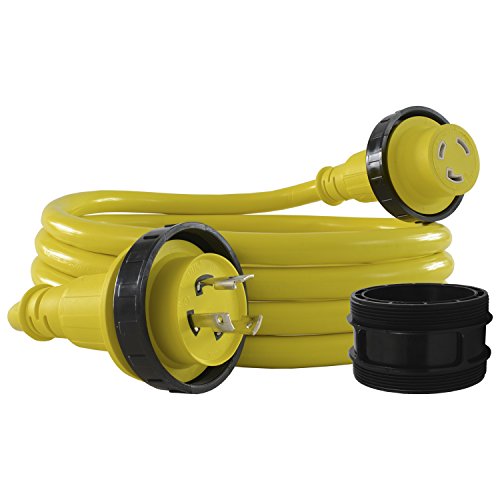
Marine Shore Power Cordset

WEATHERPROOF CONSTRUCTION: Watertight molded ends; nickel plated contacts help reduce corrosion
How to Select the Shortest Safe Cord for Your Setup
To select the shortest safe cord for your setup, measure the most direct path from your pedestal to your inlet. Add just enough length for gentle bends and service loops to prevent strain but avoid excess slack. Your goal is zero tension during full dock movement, so double-check if your berth shifts position. Shorter runs reduce voltage drop, helping you stay within that 3% limit, essential for 16A service where 1.5 mm² cable length maxes out around 17 meters. Match the conductor size to your amp load—beyond 25 meters, switch to 2.5 mm² wire to maintain safe operation. Inspect the cable insulation to ensure it can handle heat and check that your plug matches the inlet’s amperage. Never coil excess cable tightly, as trapped heat can damage connectors. Lastly, confirm proper strain relief at both ends to prevent stress on the connections. With these steps, you’ll get the shortest, safest cord for your setup.

Marine Shore Power Cordset

3.Plug and Interface Specifications: Input end of 30-amp to 15-amp plug conversion cord is 125 Volt 30 Amp Nema L5-30P three-legged twist lock (Twist Lock) male plug (with locking ring), specifically for connecting RV homes, generators and marine shore power L5-30R sockets. Output end is 125 Volt Nema 5-20R 20 Amp T-type blade (T-Blade) female socket (*Special emphasis: This is 125V Nema 5-20R, not 250V Nema 6-20R*), compatible with standard 5-15R 15A household sockets. Maximum working voltage is 125V

Compatible with Nema L5-30P to 5-15/20R: 10ft Heavy duty 30 Amp to 20 Amp shore power adapter Compatible with Nema L5-30P to 5-15/20R, ETL Listed Compatible with Nema L5-30P 125 Volt 30 Amp locking plug male to female Compatible with NEMA 5-20 20 amp T-blade receptacle, 30 to 20 amp marine adapter cord build with STW 10AWG/3 conductors power cord, Note: only work with Max 125Volt, T-Blade 20R is 125 Volt 20amp Compatible with Nema 5-20R NOT 250V 20amp Compatible with Nema 6-20R